
Outdoor Classroom, Gazebo, Canopy or Enclosed Building?
Outdoor Classroom, Gazebo, Canopy or Enclosed Building: Which Does Your School Need?
Schools looking to create additional outdoor teaching or play space are often faced with several apparently similar options. Should you choose an outdoor classroom, an open-sided gazebo, a school canopy or a fully enclosed building?
The best choice depends on how the space will be used, the number of children it needs to accommodate, the level of weather protection required and, of course, the available budget.
An open-sided gazebo may be ideal for curriculum-based outdoor learning during warmer weather, while a canopy can provide everyday shelter immediately outside the school building. A fully enclosed outdoor classroom offers considerably greater flexibility and can potentially be used throughout the year as a teaching room, SEND inclusion space or nurture provision.
Here are the principal differences to help your school decide.
What Is an Outdoor Classroom?
“Outdoor classroom” is a broad description rather than one particular type of structure. It can include anything from a simple open-sided timber shelter to a fully enclosed and insulated school building.
What makes it an outdoor classroom is principally how it is designed and used. It should provide a safe, practical and engaging place in which teaching and learning can take place outside the traditional classroom.
Outdoor classrooms can be used for:
- Curriculum-based outdoor learning
- Forest School activities
- Science and nature study
- Reading and storytelling
- Art and creative activities
- Small-group teaching
- SEND interventions
- Nurture and wellbeing sessions
- Outdoor performances
- Breaktimes and lunchtime shelter
A school should therefore begin by deciding what it wants the space to achieve. This will help determine whether an open or enclosed structure is the most appropriate solution.
What Is an Outdoor Classroom Gazebo?
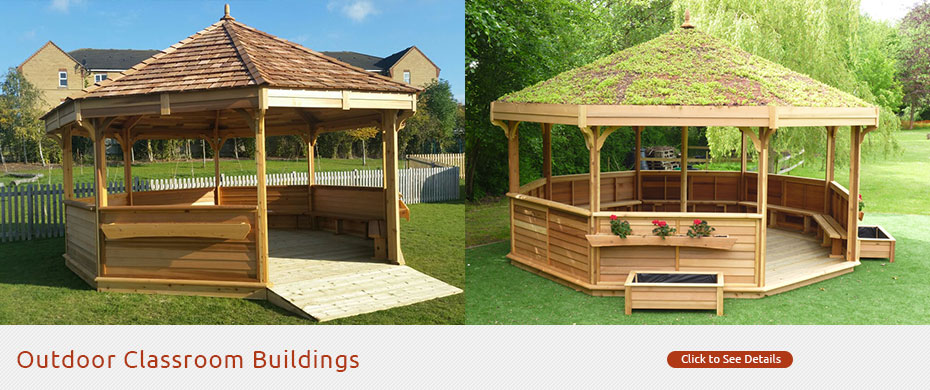
An outdoor classroom gazebo is normally a permanent, roofed structure with open sides. It may be octagonal, square or rectangular and usually contains fixed perimeter bench seating.
It provides a recognisable destination for outdoor teaching while allowing children to remain connected to the surrounding playground, garden or natural environment.
What are the advantages of a gazebo?
An open-sided gazebo provides:
- Shelter from rain and direct sunlight
- Plenty of natural light and ventilation
- Easy access from several sides
- Good visibility for supervision
- Space for a full class or smaller groups
- A comparatively affordable introduction to outdoor learning
- Relatively quick installation with limited disruption
Outdoor classroom gazebos are especially suitable for schools wanting a dedicated teaching space for use during suitable weather, without requiring a completely enclosed building.
Roll-down weather panels, solid lower panels, planters, access ramps, extended decking and renewable-energy learning equipment can also be incorporated into many designs.
Are there any disadvantages?
An open gazebo will not offer complete protection from wind, driving rain or cold temperatures. Although it can be used for much of the school year, its comfort will depend upon the weather, location and orientation.
It is also less secure than an enclosed building, so books, cushions, electrical equipment and teaching materials may need to be taken back inside after use.
An outdoor classroom gazebo will commonly suit a school that wants an attractive, flexible and cost-effective outdoor teaching space but does not require another conventional indoor room.

Eco outdoor classroom
What Is a School Canopy?
A school canopy is a covered structure usually positioned against an existing building, although freestanding versions are also available. It commonly provides a roof over part of a playground, entrance, walkway or area immediately outside a classroom.
Unlike a gazebo, a canopy does not necessarily create a separate destination within the school grounds. Its primary purpose is generally to provide practical shade and shelter.
What can a school canopy be used for?
A canopy can be useful for:
- Extending classroom activities outdoors
- Providing wet-weather play space
- Sheltering entrances and waiting areas
- Creating covered walkways between buildings
- Providing shade during warmer weather
- Protecting outdoor dining or seating areas
- Supporting free-flow learning in Early Years settings
A canopy can work particularly well where teachers want children to move easily between an indoor classroom and an adjoining outdoor area.
When might a canopy not be the best choice?
A canopy normally offers less protection than an enclosed building and may not provide the sense of being in a special or separate learning environment that a gazebo creates.
Its suitability will also depend heavily on the school building, drainage, available wall space and the position of doors and windows. If the school wants a structure in a playing field, Forest School area or separate part of the playground, a freestanding gazebo or shelter is likely to be more appropriate.

5m x 5m canvas canopy
What Is an Enclosed Outdoor Classroom?
An enclosed outdoor classroom is a secure building with walls, doors and windows. Depending upon its specification, it can also include insulation, internal lining, lighting, electrical sockets, heating and accessible entrances.
This provides the greatest level of weather protection and allows the school to use the space for a much wider range of purposes.
An enclosed outdoor classroom could become:
- An additional teaching room
- A small-group intervention room
- A SEND inclusion base
- A sensory regulation space
- A nurture or pastoral room
- An art or music studio
- A school library
- A staff or meeting room
- An alternative provision space
- A community-use facility
Why choose an enclosed building?
The most important advantage is flexibility. An enclosed and appropriately specified building can be used in weather conditions that would make an open shelter uncomfortable.
It is also lockable, allowing furniture, learning resources and equipment to remain inside. Acoustic treatment, subdued colours, blinds, insulation and carefully controlled lighting can be incorporated when the building is intended for pupils with additional needs.
For schools struggling to find sufficient space inside their existing buildings, an enclosed outdoor classroom can provide a practical alternative to a traditional extension.

7m x 4m with Sapele hardwood doors
What should schools consider?
An enclosed building will usually cost more than an open-sided structure. It may require more extensive foundations, groundworks and utility connections, and its proposed use may affect the necessary specification.
For example, a building intended as an occasional outdoor shelter will have different requirements from one used every day as a heated teaching room.
The school should establish at an early stage whether it requires:
- Insulation and internal lining
- Heating and electrical power
- Internet connectivity
- Accessible ramp or level access
- Appropriate lighting and acoustics
- Storage
- Secure doors and windows
- Tables, chairs or fixed bench seating
- Water or drainage
- Specialist SEND features
How Do the Four Options Compare?
Choose an outdoor classroom gazebo if:
Your school wants a separate, attractive and easily accessible outdoor teaching space with shelter from rain and sun. It is particularly suitable for outdoor learning, Forest School, storytelling and class activities where complete enclosure is unnecessary.
Choose a canopy if:
Your priority is to provide shade and weather protection immediately outside an existing building. Canopies are particularly useful for Early Years free-flow learning, covered play, waiting areas and walkways.
Choose an enclosed outdoor classroom if:
Your school needs a secure and highly flexible space capable of supporting regular or potentially year-round use. This is generally the strongest option for SEND provision, interventions, nurture, alternative provision and additional teaching accommodation.
Choose a bespoke combined design if:
Your school needs more than one type of space. For example, an enclosed teaching room could be combined with an open veranda, covered decking or adjoining gazebo. This provides a secure internal room together with a sheltered outdoor learning area.
Which Option Is Most Suitable for SEND Pupils?
There is no single answer because pupils’ needs differ considerably.
Some children benefit from an open shelter that allows them to step away from a busy playground without feeling separated or confined. Others need a quieter, enclosed and more carefully controlled environment in which sound, lighting, temperature and visual stimulation can be managed.
For SEND use, schools should consider:
- The reason pupils will use the space
- Whether it is intended for regulation, intervention or teaching
- The number and age of its users
- Noise from the surrounding playground
- The need for privacy alongside staff supervision
- Wheelchair and mobility access
- Lighting, colour and acoustic requirements
- Storage for sensory and learning resources
- Whether pupils will use it throughout the year
A design should be based upon the school’s actual pupils and intended use rather than simply selecting a product described as a “sensory” or “SEND” building.
How Much Does Each Option Cost?
The price will depend on size, materials, site access, ground conditions, location, chosen options and the amount of preparation required.
As a general guide, Hideout House open-sided outdoor classroom gazebos typically begin within the region of £8,000 to £15,000. Fully enclosed classrooms are more commonly within a range of approximately £15,000 to £40,000, with larger or more specialist SEND buildings potentially costing £27,000 to £40,000 or more.
Canopy prices vary considerably according to their dimensions, construction and whether they are attached to an existing building or freestanding.
Schools should check carefully what a quotation includes. The lowest initial price may not include foundations, delivery, installation, surfacing, electrical work or other necessary items.
Will Planning Permission or Building Regulations Approval Be Required?
Planning permission and Building Regulations are separate matters, and the answer will depend on the structure, its size, position, specification and intended use.
Some school buildings can be installed under permitted development rights, subject to relevant limitations and conditions. Certain small, detached structures or open-sided shelters may also be exempt from Building Regulations, but schools should not assume that every building below a particular size is automatically exempt.
Electrical work, glazing, accessibility, fire safety, proximity to boundaries and the building’s actual use may all need to be considered.
Schools should obtain confirmation from their local planning authority and Building Control body before proceeding. Hideout House can provide practical guidance based on our experience and can also produce the scaled drawings commonly required for a planning application, but the final determination rests with the appropriate authorities.
Start With the Purpose, Not the Product
The most successful outdoor learning projects begin with a clear understanding of what the school is trying to achieve.
Before requesting quotations, consider:
- Who will use the space?
- How many children must it accommodate?
- What activities will take place there?
- Will it be used throughout the year?
- Does it need to be lockable?
- Is heating, lighting or power required?
- Are there particular SEND or accessibility requirements?
- Where could it be positioned?
- What is the complete available budget?
- Could the school’s needs change in the future?
The answers may point clearly towards a canopy, gazebo or enclosed building—or suggest that a bespoke combination would provide better long-term value.
How Hideout House Can Help
The Hideout House Company has more than 20 years’ experience of creating outdoor classrooms, shelters, playground facilities and SEND environments for schools throughout the UK.
Rather than requiring schools to select an off-the-shelf structure, we can assess the proposed location, discuss how the space will be used and develop a design around the school’s needs, site and budget. We can also provide visual concepts to show how the completed structure could look within the school grounds.
If you are unsure whether your school needs an outdoor classroom gazebo, canopy, enclosed building or a combination of the three, please contact us for an informal discussion and practical advice.
Tel: 01832 275902 or email: info@hideouthouse.com


 The outdoor classroom features upper glass laminated panels to provide protection from the elements (as well as a full length canvas panel to the door/entrance) but we decided that some of these should be in coloured perspex to throw in different sensory light textures.


